AI and constitutional rights
Dignity, equality, due process, privacy and access to effective remedies.
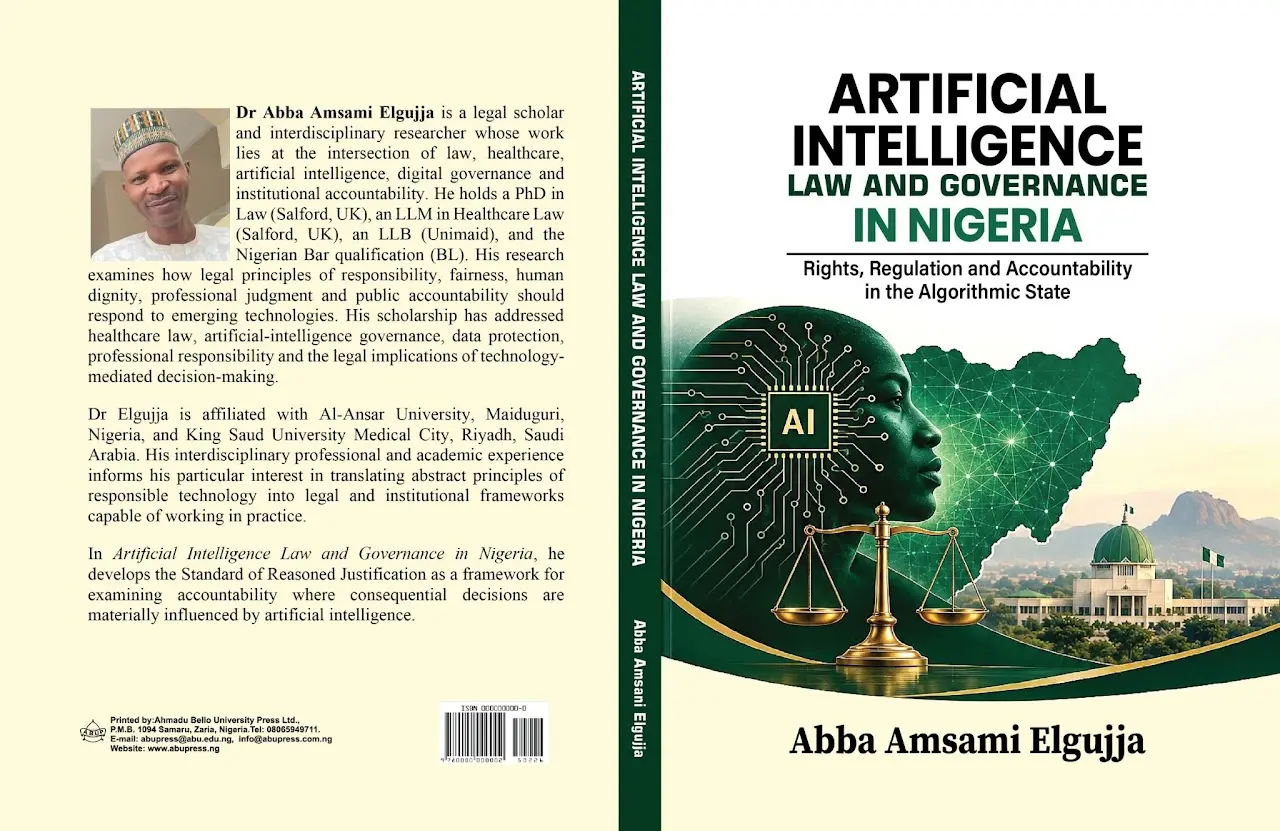
Rights, Regulation and Accountability in the Algorithmic State
A Nigerian legal framework for governing artificial intelligence without surrendering constitutional rights, human judgment or institutional accountability.
Artificial Intelligence Law and Governance in Nigeria examines how Nigerian law should respond as public institutions, businesses and professionals increasingly use artificial intelligence to inform or determine consequential decisions.
The book brings constitutional rights, administrative law, data protection, professional responsibility and sector-specific regulation into one coherent account of responsible AI governance. It considers automated and AI-assisted decision-making across healthcare, financial services, legal practice, public administration and other high-impact settings.
Its central argument is that innovation and accountability are not opposing goals. Nigeria can benefit from AI while requiring decisions that affect rights, opportunities and public services to remain lawful, transparent, reviewable and attributable to responsible human and institutional actors.
The book develops a practical framework for asking whether an AI-influenced decision can be properly explained, independently reviewed and defended against applicable constitutional, statutory, professional and ethical obligations.
The analysis moves beyond abstract ethics to the legal duties, safeguards and oversight structures required for accountable deployment.
Dignity, equality, due process, privacy and access to effective remedies.
Responsibility when algorithms materially influence public or private decisions.
Lawful processing, purpose limitation, data quality and sensitive-data safeguards.
Allocating responsibility among developers, deployers, institutions and professionals.
Meaningful reasons, contestability and records capable of supporting review.
Stronger controls for systems affecting health, liberty, livelihood and essential services.
Legality, procurement, impact assessment and administrative accountability.
Governance roles, audit, human supervision and effective enforcement.
International regulatory lessons adapted to Nigerian realities.
Imported regulatory models cannot simply be transplanted without regard to Nigeria’s constitutional order, institutional capacity and social context. The book offers a locally grounded framework while engaging with comparative and international developments—and supplies practical principles for governing systems already entering Nigerian institutions.
Formal Nigerian book launch and scholarly conversation.
The launch will bring together legal scholars, policymakers, practitioners, institutional leaders and technology stakeholders to examine the legal architecture needed for responsible AI in Nigeria. Further programme and participation details will be announced on this page.
Register your interestFollow launch updatesOfficial bibliographic and publication information for libraries, booksellers, reviewers and institutional purchasers.
Use the appropriate contact route so institutional, distribution and media enquiries can be handled efficiently.
For universities, law faculties, libraries, professional bodies, public institutions, booksellers and organisations considering course adoption or multiple-copy orders.
Send an institutional enquiry →For review copies, interviews, speaking invitations, launch coverage and scholarly or media engagement concerning the book.
Send a review or media enquiry →